Categories

CloneTracker XP 5M Barcode-3′ Library (packaged)-5 pools (pScribe4M-RFP-Puro)

22.100,00 

Quantity: 5 x 10^8 TU

    Please contact us for a quotation


    Description

    Clonetracker XP Lentiviral Barcode Libraries

    • Label 5 large cell populations of any type individually by lentiviral barcode library transduction
    • Assess how cell heterogeneity changes in response to drugs, differentiation, or disease progression (e.g. metastasis)
    • Readout by gDNA NGS and Single-Cell RNA-seq, enabled by barcode placement in the 3´UTR of the resistance gene transcript

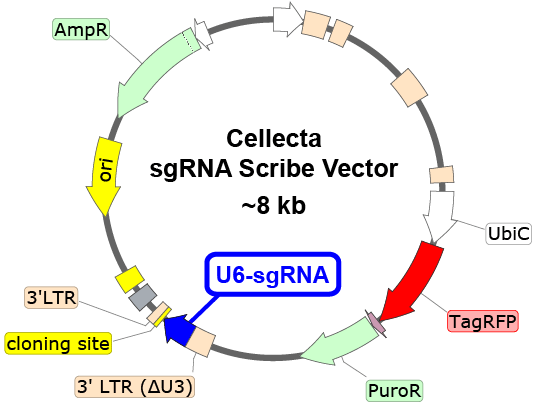
    Each 5M barcode validated, pooled lentiviral library can be used to easily label ~ 1 million cells with heritable unique RNA-expressed barcodes, detectable by RNA-Seq and single-cell analysis as well as in the genomic DNA fraction. The barcodes are non-overlapping enabling to label each cell population individually. These library pools all incorporate the barcode in the 3′-UTR of a transcript, which is compatible with oligo-dT cDNA synthesis protocols.

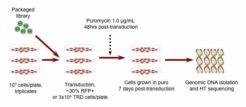
    Cellecta’s CloneTracker XP™ Barcode-3’ Libraries are pooled barcode libraries that enable the tracking of individual clones derived from a population of cells using either RNA-Seq or PCR/NGS from genomic DNA. Each of the five libraries provided in a lentiviral vector backbone contains about 5 million constructs, each expressing a unique barcode sequence. When a limited cell population is transduced with a barcode library, the barcodes integrate into the genomic DNA of the cells. The result is a founder population where almost every cell has a different DNA-sequenceable barcode that is both integrated into its DNA and expressed on an RNA transcript. Since the barcode is stably integrated, it is passed onto any cell progeny when genomic DNA is replicated. This feature enables identification of all the progeny derived from each individual cell.
    When used in conjunction with single-cell RNA-Seq (scRNA-Seq), the expressed barcode may be used to identify expression profiles and activated genes in different cells so that distinct clonal populations of cells from a single progenitor, as well as sub-populations of cells with distinct pathway activations or expression profiles, can be readily identified.
    The specially-designed, optimized barcodes facilitate Next-Gen Sequencing (NGS) data analysis and barcode identification. Using the Illumina NGS platform, barcode sequences can be identified either by RNA-Seq or PCR/NGS from genomic DNA and converted to lists with enumerated data.

    Shipping Conditions: Dry Ice
    Storage Temperature: -80C